STARLab
Rover Projects

Rover Projects

Wheel Slip Identification and Mitigation

Robotic missions to Mars and the Moon will increase over the next several decades. Rovers are a critical tool used in these missions, and they are constrained
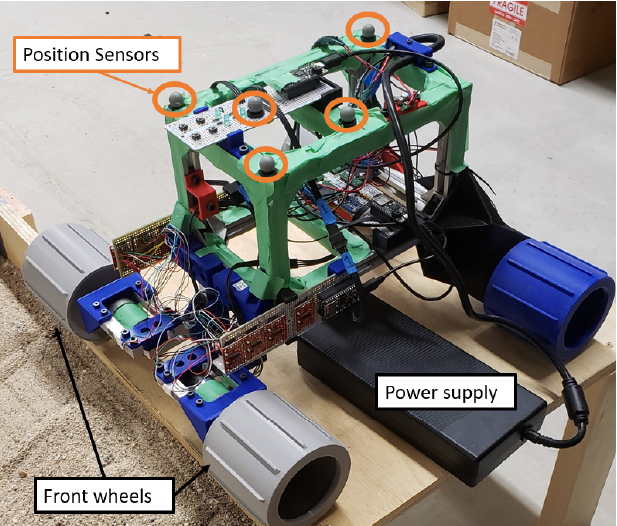
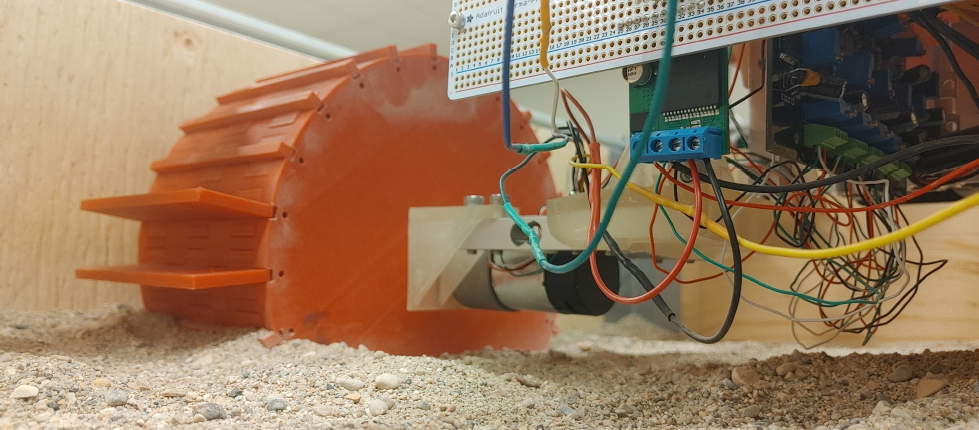
by challenges stemming from wheel slippage and slip-mitigation. This project introduces three contributions to address these areas. First,  a novel metric called ‘virtual slippage” to quantify wheel slippage by relating it to an effective change in wheel radius. Secondly, I study the feasibility of using auto and cross-correlation to detect wheel slippage. I found autocorrelation insufficient for slippage detection;  cross-correlation and raw sensor data was used to train a neural network to detect slippage with an error of 0:07 to 0:1 classic slippage, or 0:02 to 0:5 cm using virtual slip on a 10 cm diameter wheel. Thirdly, I study the efficacy of asymmetrical wheel designs to mitigate and aid in escaping high-slip environments. By expanding and introducing the new definition of wheel slippage and new detection methods, this research paves the way for improved traction control on granular surfaces and improved manoeuvrability of extra-planetary rovers. I developed these tools to improve the success of future exploration missions for celestial bodies and improvements for terrestrial applications here on Earth.

Image Caption: Damage to the Curiosity rover wheel as of Sol 164

Relating Virtual Slip of Rover Wheels to Soil Motion

The field of terramechanics concerns understanding how wheels interact with soil, with the goal of creating
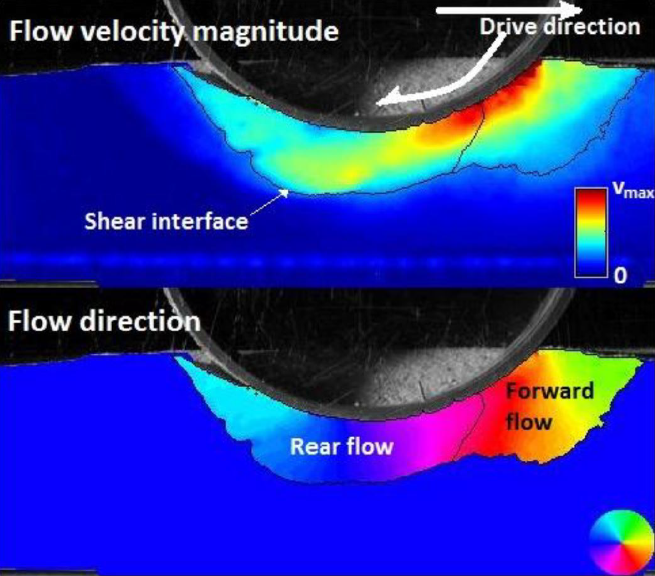
wheels of increased performance. A method used in terramechanics is creating vector fields of soil motion
underneath a wheel, which gives insight into the relationship between soil motion and wheel performance.
This project contributes to the field of terramechanics using a soil motion algorithm to determine the
relationship between two metrics: boundary layer thickness of soil and virtual slip. If a relationship is
determined, a method will be created for determining the optimal grouser length of wheels in cohesionless
soil.

Image Caption: Vector fields produced with SIIA

Conceptual Design and Analysis of a Morphing Extraterrestrial Rover Wheel for Travel in Fine Particle

Following critical rover mission failures such as those experienced by NASA’s Spirit, the engineering community has devoted research into improving rover traction in difficult, high slip substrate. While most focus on improving vehicle control mechanisms to navigate difficult substrate others seek mechanical solutions to this problem that involve changing the wheels structure. Changes to the wheel structure such as introducing flexible interface materials or expanding wheel
radius have been studied for the purpose of improving motion in FPS. However, studies that examine
the direct application of a morphing wheel design on a rover have not been studied extensively. This study examines improving rover locomotion using morphing wheels that adapt appropriately to navigate through FPS terrain. To assess performance, common metrics such as wheel slip and speed will be used. The information gained will serve as a foundation for similar concepts or continued optimization of the one tested.