

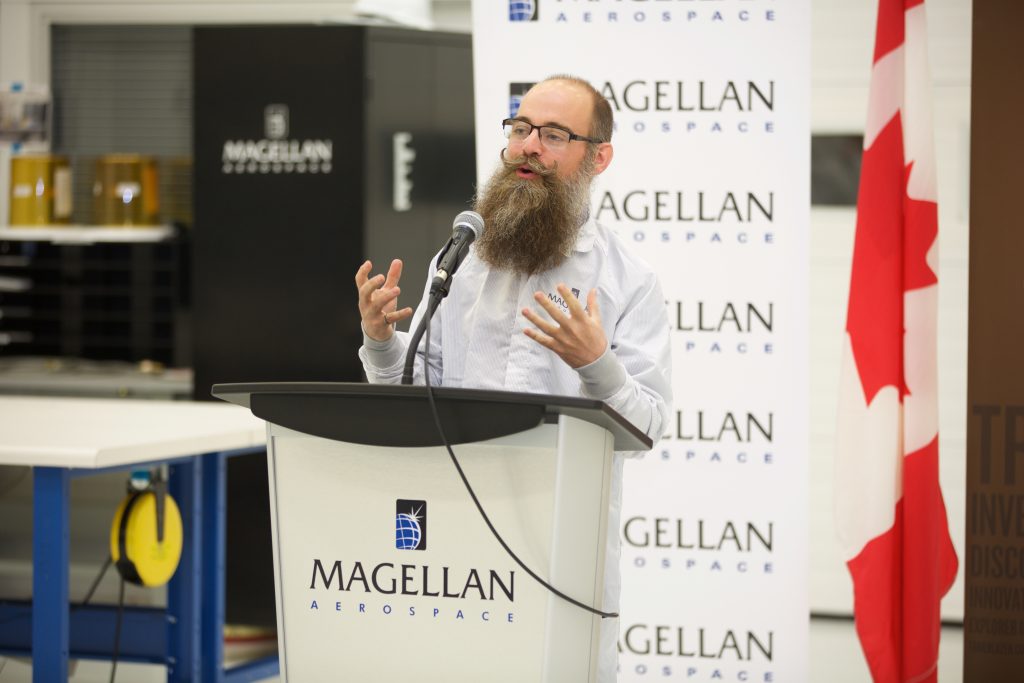
.Philip Ferguson founded the University of Manitoba Space Technology and Advanced Research Laboratory (STARlab) in 2017.
Our Mission is to make space accessible through technology development and innovation.


Mission
To research and develop new technologies that improve access to aerospace products and services.

Vision
To empower communities with modern aerospace technology, making them resilient to a rapidly changing environmental and geopolitical climate.
How it all Began...
Dr. Philip Ferguson founded the Space Technology and Advanced Research Laboratory (STARLab) in 2017. After spending more than a decade working on prolific space systems such as the International Space Station’s robot arms (Canadarm2 and Dextre), space telescopes like the Microvariability and Oscillations of Stars (MOST) and the Near Earth Object Surveillance Satellite (NEOSSat), and the Radarsat Constellation Mission (RCM) satellites, Dr. Ferguson noted that aerospace systems and the benefits they provide needed a reboot towards accessibility.
Communities in northern Canada, experiencing climate change four times faster than the rest of the planet need on-demand information about how the ice is changing. They require data about the increase in marine ship traffic as the ships alter animal migration and pose chemical spill threats. Unpredictable weather patterns are making search and rescue missions a weekly occurrence, requiring precise localization and communication. With geopolitical tensions rising at seemingly every corner of the globe, real people in real communities need high-speed connectivity and information. Aerospace technology in the form of drones, airships, spacecraft, and planetary rovers can provide solutions to these and more challenges, but we need research to explore the accessibility of these technologies.
At STARLab, we note the tremendous growth in launch services over the past few years. These days, rockets launch several times per week, providing unprecedented access to space. However, the technology we put on those rockets and its usability and trustworthiness is lagging.
Every year researchers from around the world write millions of journal articles and conference papers filled with genius ideas on how to better control spacecraft, guide a drone, or drive a rover. And yet, only a small fraction of those new technologies find their way into implementation. There are likely numerous reasons for this gap (often referred to as the “Valley of Death”), but STARLab researchers point squarely at confidence, or the lack thereof. End users that have confidence in technology will readily understand it, leverage it, adopt it, and ultimately trust it. Without that confidence, technology remains in academic literature.
This is why STARLab has focused our research on improving confidence. We innovate new testbeds and verification techniques that aim to demonstrate technologies in real and operational environments. We leverage artificial intelligence to not just learn the right ways to control and navigate, but also to learn how to predict expected errors and training times. We explore truly cross-disciplinary research topics that blur the lines between traditional engineering departments, asking questions about the cross-functional impacts of structural optimization on electrical and even software design. We research how people (REAL people) interact with the technology we create.
Most importantly, STARLab co-develops systems and technologies with communities. STARLab understands that researchers come from many different backgrounds, cultures, ethnicities, and communities. Some have spent years or decades earning degrees in traditional Western schools, while others have spent their lives learning by doing in remote northern communities. But we are all researchers. Our diversity makes us strong in STARLab, and the community co-developed nature of our research brings meaning and purpose.
STARLab’s goal is a more accessible aerospace sector that provides solutions for communities. Please explore this website to learn more about the research we do at STARLab.